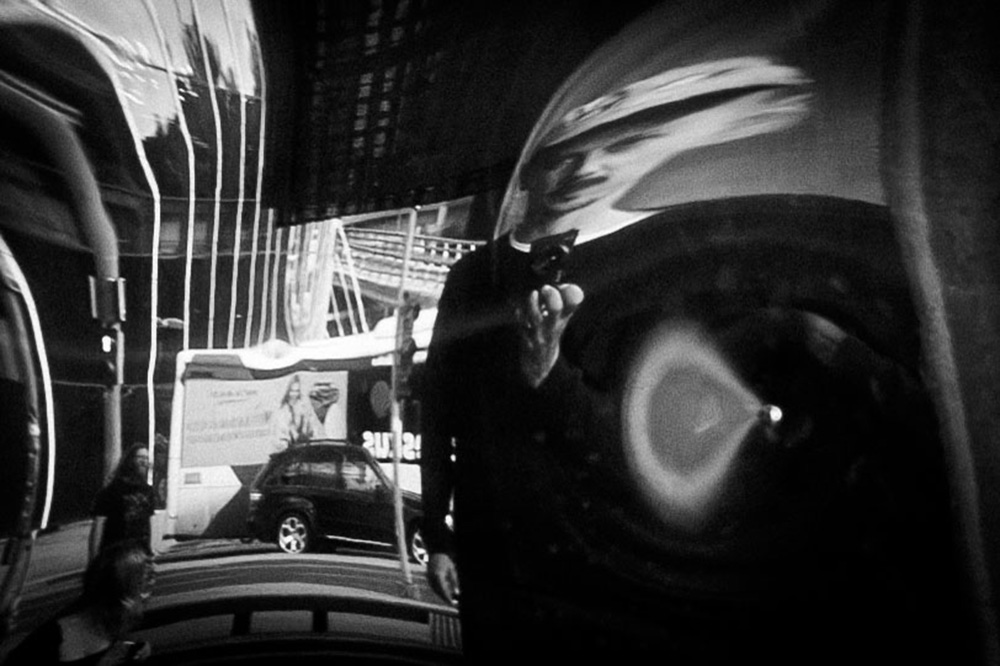
Danish photographer Peter Rask has, through his travels, ended up in Tallinn. He has discovered nocturnal street life and misty atmospheres for himself. How he found his style and what he thinks about street photography becomes clear in the interview below.
How did you discover street photography for yourself?
My father was very interested in photography, and I remember him often carrying his camera around when I was a child. My older brother also started shooting street photography about ten years ago, and I’ve always been fascinated by his style. At the same time, I never felt the need to pursue it myself. That changed when I travelled to India in 2017 and my brother lent me a Fuji X100T. On that trip I understood that I actually have a strong connection to photography that was, so to speak, waiting to be discovered. So I started by taking random holiday photos of people I saw on the streets, and that sparked a strong interest in the concept of street photography.

What does street photography mean to you?
For me, walking the streets and taking photos is like therapy. The combination of fresh air, exercise, and the chance to capture a specific scene makes me forget everything else for a moment. It’s an active way to express my creative side and it clears my head. Sometimes when I’m out shooting, I even forget basic needs—like drinking or eating.
You mostly shoot at night or in low light. How did you arrive at that style? Does it require more technical skills?
Actually, I like shooting in all kinds of light. I enjoy photographing silhouettes, shadows, sunsets, reflections, and funny characters. It depends on where I am, what season it is, and what time of day it is. I didn’t have a specific style until December 2019, when my girlfriend and I went on a four-month trip to Asia. One evening, a small mountain town in Northern Vietnam surprised me. We had been trekking in the mountains all day and arrived in a small village to eat and rest our legs. The town was covered in thick fog that rolled in every 15 minutes or so, and the mix of neon signs, street lights, and fog made it feel like we were part of the “Blade Runner” movie. My jaw dropped. I completely ignored how much my legs hurt and couldn’t stop shooting. After two hours of photographing, my batteries died—but I knew I had witnessed something unique and special, and it was documented inside my camera.

I think that experience was a turning point in finding the style I still like to shoot today. In my opinion, night photography is especially beautiful, emotional, and mysterious. This side of photography deserves much more attention and recognition. I wouldn’t say shooting in the evening or at night requires a lot of knowledge—just paying attention to a few things. I mostly focus on shutter speed and ISO (the sensor’s sensitivity). Usually I keep the aperture as wide open as possible—f/1.2 to f/2.0. I set shutter speed between 1/125 and 1/250, and ISO between 1600 and 2500. Shooting at night does require a steady hand, though. I tend to plan my images quite a lot, and there often isn’t much room to change direction if I want a sharp night frame.

Who or what has influenced you the most in photography?
I tend to find inspiration from many people. At the same time, I wouldn’t say I have a mentor or one specific direction I’m aiming for in photography. I like many different genres and styles. Of course, there are photographers I really admire. I have a weakness for cinematic photography. I love the work of Oliver Takáč (@olivertakac). He really masters a dark, film-like mood in photography. My brother Jonas (@jonas.rask) has always inspired me as well—he has an amazing eye for spotting symmetrical minimalism. There are also many talented photographers in New York, for example Billy Dinh (@billydee), Nikolas Miller (@nickmillers), and Alexander Zalokar (@a_l_x_ender). One of my favourites is a great guy from Portugal, Henri Prestes (@henrifilm). I found him about four months ago and his style is something I really admire and draw inspiration from. It also helps to live in a place where there are foggy conditions on most days of the year.

You’ve photographed in different parts of the world. Where has it been the most exciting to practise street photography? Do you have a favourite place?
It’s hard to choose a favourite, but I have to say India is a place I’d gladly return to. If I had had in 2017 the knowledge I have today, India would definitely be at the top. Rio de Janeiro was also a very beautiful place to photograph, and of course Vietnam left me speechless. There are a few places I still want to visit—Tokyo, New York, and Portugal. Ideally, it would be a place where the weather is changeable and skyscrapers mix with neon light and umbrellas. That would feel like home.

How did you end up shooting in Estonia? Do you think Estonia has enough places to shoot, or is it rather one-dimensional?
My girlfriend is Estonian and we decided to settle here more permanently last year. I really like Tallinn, and the city impressed me on many levels. I didn’t know much about the Baltics before I first came here in 2016, and I was very surprised by your food, culture, and what Tallinn has to offer in general. Shooting on Tallinn’s streets can be challenging, and I’ve spent many hours searching for special places and angles. I wouldn’t say it’s boring, but it is definitely challenging. In the end, I believe it all depends on what emotion you want to capture and what scenarios you manage to catch. I think it’s important to highlight the everyday beauty of Tallinn and its residents, and turn the ordinary into something unique and special—at least that’s what I’m trying to do with my photos.
Do you have a specific approach when you go out, or do you just walk around and see what catches your eye?
As mentioned, Tallinn can be hard to capture. It’s not a big city and people tend to notice you when you shoot, so the surprise element that (in my opinion) can make a photo better is harder to achieve here. I always have something in mind when I go out. In summer it’s easier to make more “classic” street photos because there are more people around and the sun helps create anonymity, beautiful shadows, and silhouettes. In winter, though, I’m very dependent on the weather. There should be rain, fog, or snow if I want to go out shooting. I love umbrellas, hats, and elderly people. If I see a man with a hat, I might follow him a bit—which might look creepy to some—but there’s just something about those hats that makes a photo so much more interesting to me.

Candid (photographing a subject without them knowing) or staged—which do you prefer, and why?
I prefer candid photos. I think there are multiple layers to this question, but I like the randomness in shooting. One of the most beautiful things about street photography is authenticity. That said, I have occasionally handed my girlfriend an umbrella when I’ve seen a great scene but there weren’t enough people for it to work—so sometimes it blends with more “ordinary” street scenarios, but it isn’t fully staged. I’d also really like to do more portraits and staged frames with a strong emotional expression. My interest in that has grown over the last six months, and I hope I’ll be able to try it in the near future.

How do you usually edit your photos?
It depends a lot on what I want to express. I use only the Snapseed mobile app to edit my photos. Sometimes I also use Lightroom for larger prints where the image needs to be especially crisp. But I’m also a bit lazy when it comes to editing. I do have a specific image in mind when I edit, and it varies—from adding sharpness to playing with white balance and light. But I never deceive the viewer. I’ve never added things that weren’t already in the frame. In my opinion, using Photoshop isn’t real photography for me—then it becomes digital art, which is fine, but I just wouldn’t describe it as real street photography.
What equipment do you use? Do you think gear plays an important role?
I use Fujifilm gear—specifically a Fuji X-T2—and I have three lenses: 23mm f/2, 50mm f/2, and 56mm f/1.2. I also have a Fuji X100V. I definitely don’t think equipment matters if you want to take great photos. I think the most important thing is to get to know your camera—how it works and what it’s capable of. Once you know that, you also know what it can’t do, and you can work within what fits your needs. Most cameras today deliver excellent image quality, and even mobile phones have become amazing cameras. A good example that gear doesn’t determine your ability to make great photos is @hojjathamidi. He shoots only with an iPhone, and his images are, in my opinion, simply great.

Do you have any good tips for becoming a better street photographer?
I think you have to walk for the sake of walking, and shoot for the sake of shooting. Photograph whatever feels interesting. Experiment and have fun at the same time. You can really only learn photography by practising. Many people get frustrated when they can’t find their style. I had those thoughts too. I think it takes time to find your path. My style is definitely foggy night photography. I wish Tallinn had fog more than two days a year.
Could you share the story behind one of your photos?

I took this photo in Helsinki in 2018. It kind of sums up what I love about street photography. At that time I was still experimenting a lot, and this is one of the great moments I remember: the mural on the wall under a staircase, a subject jumping into the frame by chance, and on top of that, the perfect black-and-white lines. I stood there for quite a while thinking about how to capture an interesting angle, and then suddenly this man entered the frame and I managed to catch him. This photo didn’t get much attention on Instagram, but the timing and the coincidence still fascinate me to this day.
You can see more of Peter’s work on Instagram.