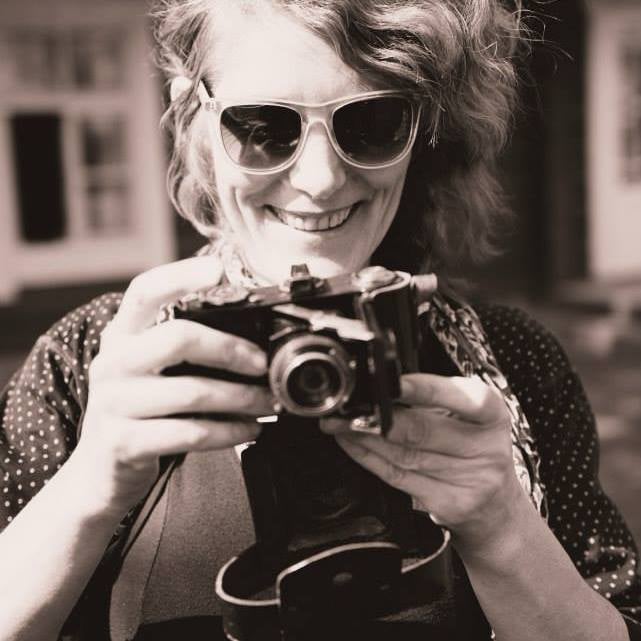
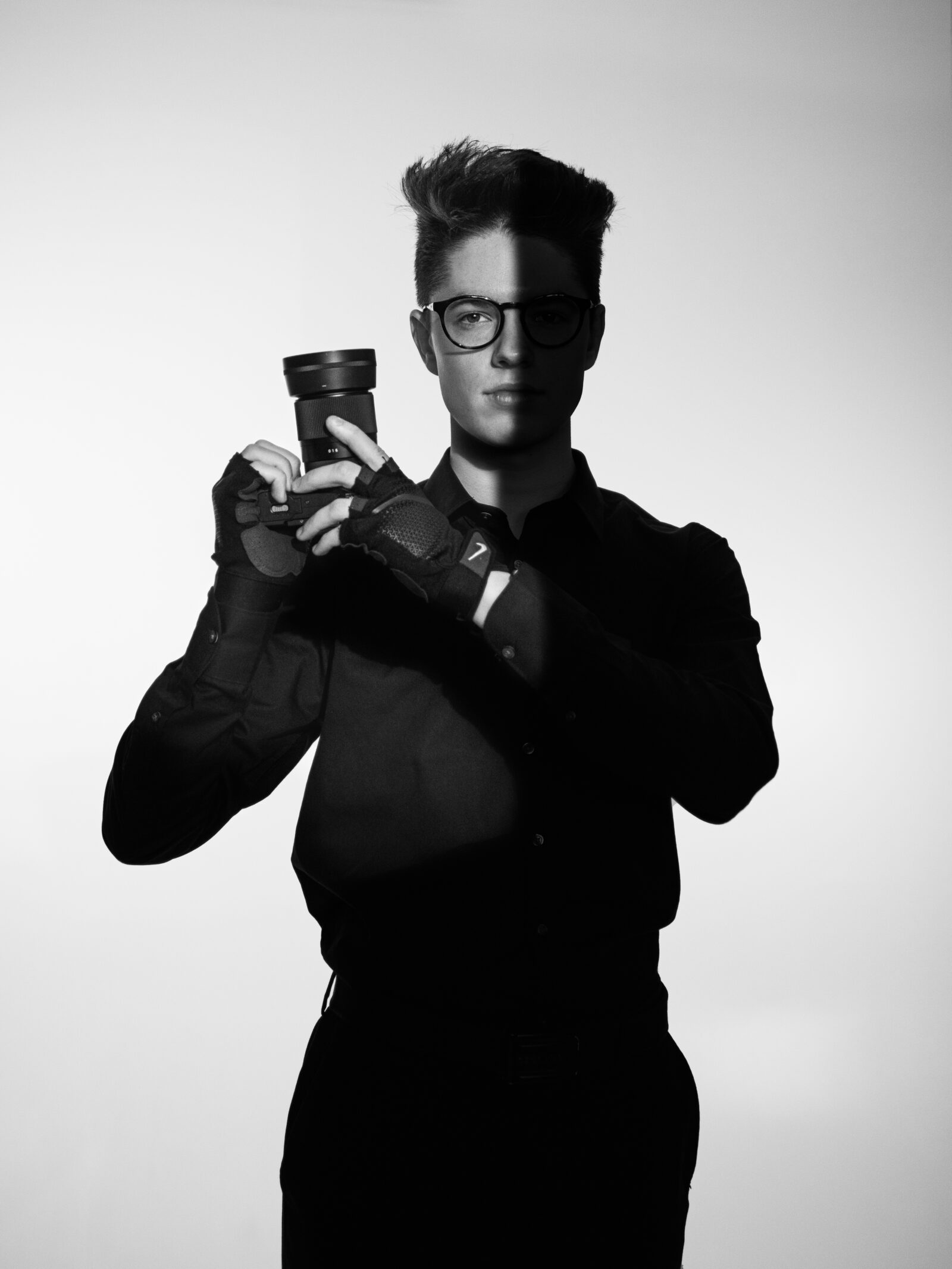
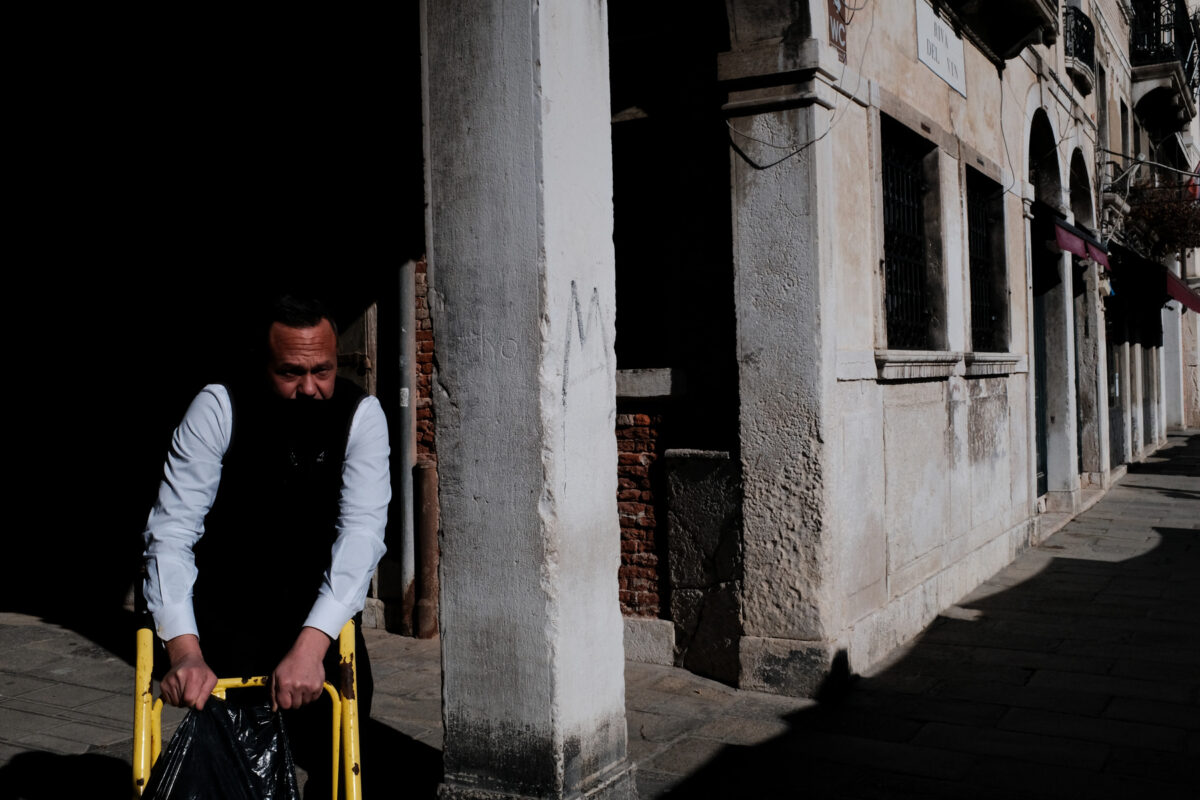
Francesco Cremonese is an Italian photographer, currently living and studying in Tallinn. He likes to catch light and shadow and is interested in discovering new parts of town with his camera. Francesco talked about street photography and his work.
How did you find street photography? Why did you decide to shoot on street?
Well it’s difficult to give a straight answer. It’s like a sort of process that starts slowly. You start taking pictures of your friends, then you take pictures of flowers or whatever.. then you look around, you see a nice building, you want to take a picture of that and find different angles. I do like to explore this path, which is street photography, so there’s no straight answer here.
I´ve been influenced by many photographers, they have been very important. Maybe one of the reasons is that a friend recommended to me this photographer called Letizia Battaglia. She’s a great Italian photographer, she has been doing reportage for all of her life. I was really hit by her pictures and after that I kind of tried to mimic her style. So you kind of find your own way of how to take pictures.
What does street photography mean to you?
I think it’s self expression mostly and I guess I need to think about this more. I think it’s finding something unusual in the picture. For example I took a tram to the university and I saw a guy dancing there and I really regret I didn’t have my camera then. It’s moments like this that need capturing.
Also it’s a way to refine a sort of aesthetic approach, sort of aesthetic research like the way that I try to explore with shadows, trying to find out how this works and stuff like this are important.
You have this project called “Redeemed”. Can you explain it a bit more.
Maybe I should give a background first. Venice has this 500 year old tradition, that is called “Redentore”, that means the redeemer ‒ the one, that redeems people. For this occasion they build a bridge that connects the main island to another island in Venice and people walk on this bridge as a sort of way to get redeemed. It’s like a ritual, but now it´s lost its full meaning, because now everything is more touristic. But it’s that idea of getting redemption and going from one place to another as a sort of ritual.
I wanted to build on this a sort of meaning that I couldn’t explain very well. I wanted to build on this connection with this religious meaning and what I could see, because it wasn’t religious, it was more like a party with people mostly getting drunk, there are fireworks and it’s important for the city, but I wanted to explore the religious connection. I´ve seen the bridge many times and I want to explore this idea more. I’m not sure it´is finished yet.
You used mostly black and white on this project. Why?
It’s on purpose, but mostly because of the aesthetic purposes, not like a sort of symbolism to use black and white instead of colours. I just thought it might work better in this way.
You have another project called “Veils”. Can you tell us more about it.
It was connected to the corona times. It was 2019, the year of the virus. One of the only film festivals that opened was Venice International Film Festival and because of that I wanted to explore that festival with these kind of restrictions. You had to pass two security gates, one because of terrorism security and the other one for the body temperature check for covid.
I shot these inside the area of the festival. While there were huge debates in Italy, they were raging regarding the closure of theatres and any form of live performed spectacle, the success of this ‘casualties-free’ edition made it an emblem of both culture and resilience by showing the importance of cinema has in such a critical conditions, and in addition its ability to exist during these times.
You shoot in Italy and Estonia now, right.
I started in Italy, but since I’m here, I shoot in Estonia as well.
Do you see any differences when shooting?
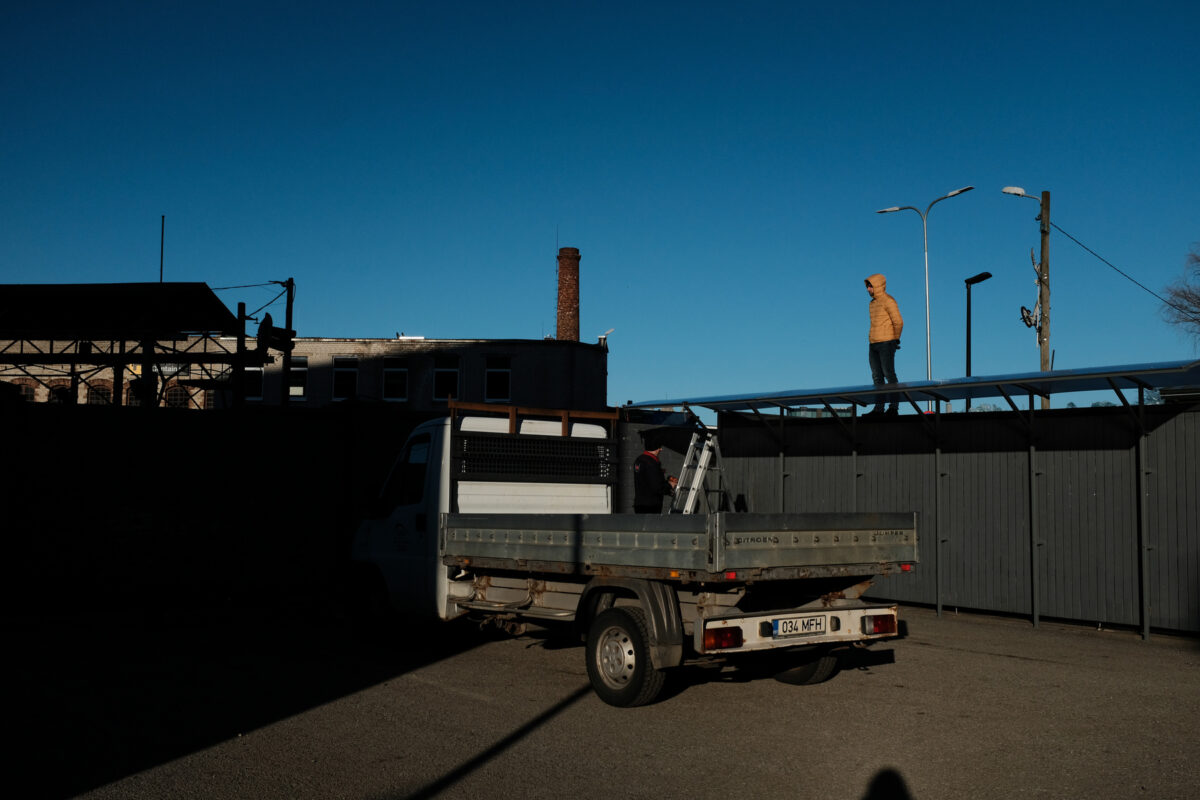
Actually I think this place works really great, because in summer you have a lot of sun all the time and in winter, when the sun is out, it’s not in an annoying position, usually it’s out on the side, so you can do beautiful portraits and you have a good light. I think Tallinn is interesting when you think of a photographic side.
As far as it concerns people, I can see many differences, like I got assaulted in both places (nothing serious though), but maybe in Italy they like to be more nosy and they try to talk to you or they get angry when you take pictures. Here people are less interested in being photographed.
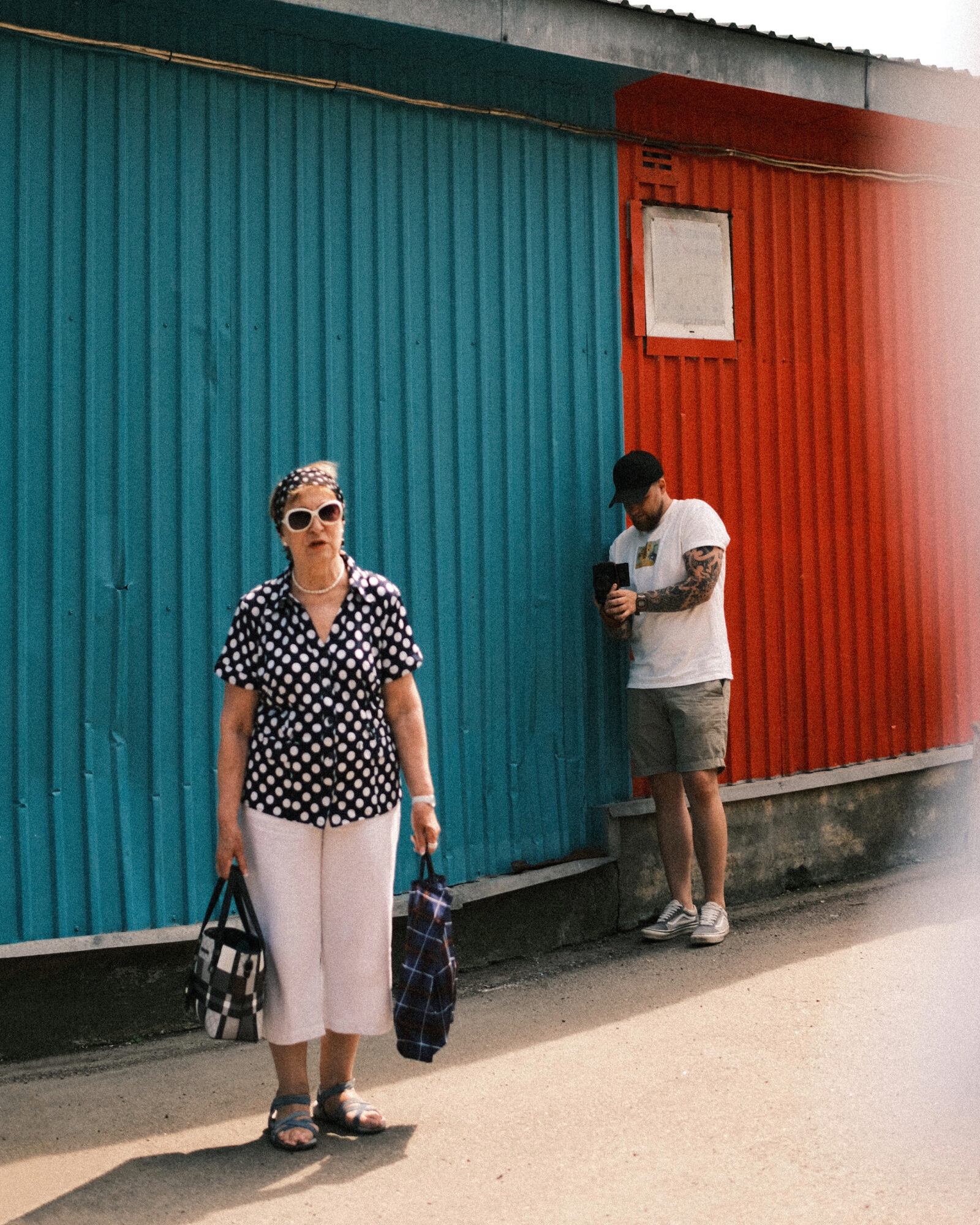
What concerns the environment, I think here works better for me, because I really like how the modern architecture blends well with the old part. In Italy we have a lot of beautiful buildings and whatever, but not all of them works very well on photos. If you have to build some geometry, it’s more difficult to get the shot in Italy, whereas here I feel like I can play a lot more with geometry.
How did you end up shooting in Estonia?
I´m studying cinematography at BFM (Baltic Film and Media School), and I liked street photography even before I moved here. So when I settled here, I just kept on doing this. It’s just been different ‒ the geometry, the weather, the sunlight. Just it took a little bit of accustomed to get used to the different environment, especially what concerns the shooting approach.
What do you think has been the most interesting place to shoot at?
I don’t think I can give a certain spot. Looking back on the whole process and all of the places that I have visited, it’s difficult to say what works better, because I was different at that time, I was pursuing different things, so the things that work better at that time are now different.
So I´m not sure, I think for now Estonia has been really interesting and maybe the best has been Venice so far.
Do you feel like there are enough shooting spots here?
Yes, not only in the old town, but I´ve been to Tartu and I found a lot of places that were interesting to take pictures. Then I recently discovered the freedom monument in Pirita, which is a nice place to shoot at. I think I´ve been to most of the places in Tallinn, but I also like to explore more parts of Kopli and Paljassaare.
Do you have something specific in mind when you hit the streets?
Depends how I am approaching it, because there have been times that I just go to a store and bring the camera with me and that’s it. Other times I am going out to take some photos and I want to have some specific shot. Depending on these approaches maybe the ones, that are more laid back, are not worth explaining, but the ones that are serious, I try to get the right light, explore the place, remember the places I walk by. Like some days before I´ve been to that place and I remember the light was good at that time, I go back with my camera and say OK, I´m going to take this picture, or I see someone interesting walk by. It’s a lot of research and waiting.
Sometimes it happens that I have all the beautiful scenes, a perfect shot in my mind is laid down there, and then I don’t have my camera with me and it feels miserable.
Do you have any favourite photographers that have inspired you?
Letizia Battaglia, Alex Webb and Tatsuo Suzuki.
You mostly play with light and shadows. Is it an intentional approach?
Yes it is. I work a lot with spot metering and I try to catch this kind of feeling, the aesthetic things. I try to figure out the environment and then focus on the lighting.
Candid or staged photography?
Well staged is not street photography in my opinion. So I prefer candid. These times it’s difficult to say what is staged and what is not. I guess if the picture looks nice, I´m fine with that. Maybe it’s a bit different from pure street photography, but at the same time I don’t judge it in a negative way. But candid is my way to go.
When I go out shooting I don’t do it this way (staged), it’s not my approach.
You use both black & white and colours.
I used to shoot more black and white, but now I’m switching more towards colours. I think it’s a more functional way of thinking. I can still make it black & white later if I feel like it. But I think the kind of style I do, I work a lot with colours as I have a lot of negative space, like shadows, I can exclude a lot of dirt from the pictures and focus on other elements. Having the colours makes it more difficult, but also more appealing.
Whenever I go out, I do all colours, but there are times when I go out and I might see some protest or event and I feel like OK, I can shoot black & white and then I just stick to it. I don’t rely on much of the post production process, I like to have all the stuff lined out at the spot. I even didn’t shoot in RAW for some time. Recently I changed my mind, but mostly I work with JPEG, because I don’t like to edit much.
So you don’t edit your photos at all?
I do like to play with the colour grading, but that’s not something I really do with my pictures. So I usually work with contrast, maybe if it’s out levelled, I just fix it. I do just the basic stuff, I think that’s all. The thing is get them good in camera first and then you can work with that.
How important do you find the technology and equipment in all of this?
I think that I rely on the fact that my camera is a Fujifilm, because it’s compact and there is not something that people can see a mile away. The shutter noise is also not that loud, so you can take a lot of pictures without anyone noticing.
I like the approach that this camera gives you. It kind of connects me with reportage photography, what was before digital times. It’s kind of interesting as an experience. However at the same time that’s not my case, but how one person feels towards the photography, it can be achieved with any camera, it doesn’t matter what brand it is.
Do you have any good tips for beginners?
Well reading the camera manual first of all is really important. Try to find your own set ups. Try to go for analog cameras and try to do the same kind of shot you would do with the digital camera.
Also be brave, just because sometimes it might seem scary. Even if somebody is very close to you and you find him/her interesting, try to take a photo, because it might be that they are not going to say anything, otherwise there’s always the possibility to apologise and delete the picture after, if they didn’t like it.
Did you have anything similar happening to you?
Yes, I was in Rome, he was a bus driver and he was about to leave the bus when he approached me. I actually wasn’t doing anything. I was thinking about it, but I didn’t take a picture, but he kept bothering me. So yes, this kind of stuff happens, but it’s mostly when people don’t want to be on camera, probably because there’s a reason behind it, I wonder.